Best Casters for Bakery Ovens - High-Temperature Guide
The Definitive Guide to High-Temperature Casters for Ovens and Hot Workshop Carts
Are your tools broke in extremely hot areas? This is a frequent and important issue. A caster wheel fails under high temperature. Casters bend at heat. Regular casters are not for these applications. You will get information about how to select the right casters. We will assist you to maintain a safe and smooth operation. Perhaps you require casters for bakery ovens or casters for hot workshop carts.
.png)
Key Takeaways
-
Standard casters in high heat do not work as the wheel material melts. The rig bends. The bearing grease does not work at high heat.
-
Wheel material options are special phenolic, nylon/PA high-temp options, and cast iron for ultra hot conditions.
-
The grease and bearing are as vital as the wheel. Always go for a bearing grease that is heat resistant.
-
Base the casters on temperature, load, environment, and flooring.
-
Specific uses, such as casters for proofing/baking racks or casters for ceramic kilns, require different wheel setups.
Why Common Casters Fail in High Temperatures
You should know why your casters are malfunctioning. This is the first step toward a solution. Every time you put a standard caster in a high-temperature environment, it will suffer in multiple ways. This results in expensive downtimes, and it can even create severe safety issues.
Wheels that Melt and Deform
Most caster wheels are made of rubber or plastic. These materials are not intended for high temperatures. When they exceed the temperature threshold, they start to degrade.
For example, you are likely to observe their behavior like the wheel losing its stiffness. It gets stuck to the floor or it cracks. The wheel sometimes can develop a flat when it returns to a cooler state. This will cause the cart to be difficult to push. A common scenario is that the casters used on powder coat ovens will have completely melted wheels. The setup is then un-operational.
Failure of Bearing and Grease
One of the most common failure points we see is the bearing. The explanation is straightforward. The reason for the bearing grease is that they fail at high temperatures. Regular grease melts, evaporates, or hardens turning to carbon.
This is the time when the metal ball bearings become dry. With no oil, they scrape against each other which leads to the issue of getting the bearing to rotate. As a result, the cart becomes difficult to push and may even stop rolling completely. This is a significant matter that should be taken care of by every supplier dealing with heat-resistant casters.
.png)
Rig and Raceway Issues
The rig is the metal part of the caster. It can also fail. Elevated temperatures can affect the strength of the steel. Under excessive load, the rig can bend or distort.
The swivel part is the part of the raceway. It has grease in it too. When that grease fails, the caster will not turn properly. This makes steering the cart almost impossible.
The Answer: High-Temp Materials for Casters
As a high temperature caster wheel manufacturer, we realize that the right materials are the basis of good performance. A true high-temperature caster is a system. The wheel, bearing, and rig all work together to handle heat.
Understanding Hot Wheel Materials
Choosing the right wheel is your first important task. Different materials work better at different temperatures and come with different benefits.
Phenolic Wheel Casters: They are a very good general-purpose wheel for dry heat. They are made of resin compound that is hard. They are excellent for heat but can be brittle. They may break from the impact of something sharp.
High-Temp Glass-Filled Nylon (PA) Wheel: This is the best material to use for the carts in bakery ovens. The glass fibers not only provide added strength but also add heat-resistance. They will roll smoothly and not mark floors. They are also resistant to oils and fats thus they are ideal for food service applications.
.png)
Ductile or Cast Iron Wheels: Only metal wheels can take the extreme heat of the casters for ceramic kilns. They are the ones that can withstand the very high temperature and heavy weight. On the downside, however, they are noisy and may damage the concrete floor.
| Material | Continuous Temp Range | Intermittent Temp Range | Pros | Cons | Ideal For |
|---|---|---|---|---|---|
| Phenolic | ~425°F (218°C) | ~475°F (245°C) | Cost-effective, hard | Brittle, can crack | Dry ovens, general hot workshop carts |
| Glass-Filled Nylon | ~480°F (250°C) | ~550°F (287°C) | Smooth, non-marking | Higher cost | Bakery oven racks, food service |
| Cast Iron | ~800°F (425°C) | ~800°F (425°C) | Highest heat, durable | Noisy, damages floors | Ceramic kilns, industrial furnaces |
The Unseen Heroes: Bearings and Grease
What good would a high-temperature wheel be if it doesn't have an adequate bearing? The heat-resistant grease bearing is the thing that makes your cart move.
Special grease is made with graphite in most cases. This will not burn off at high temperatures. It can be operational up to 600°F (315°C) or more. For the most extreme heat, a sintered iron bushing is the best option. It doesn't need grease.
Advanced Caster Features
For some jobs, you may require additional features. The design with a heat shield is a metal disk above the wheel. It will help to deflect heat from the sensitive bearing and raceway.
The rig material should be considered as well. In most cases, a standard zinc-plated steel rig is acceptable for hot workshop carts, However, in the food service or washdown areas, a stainless steel rig is necessary to avoid rust.
How to Choose the Best Caster
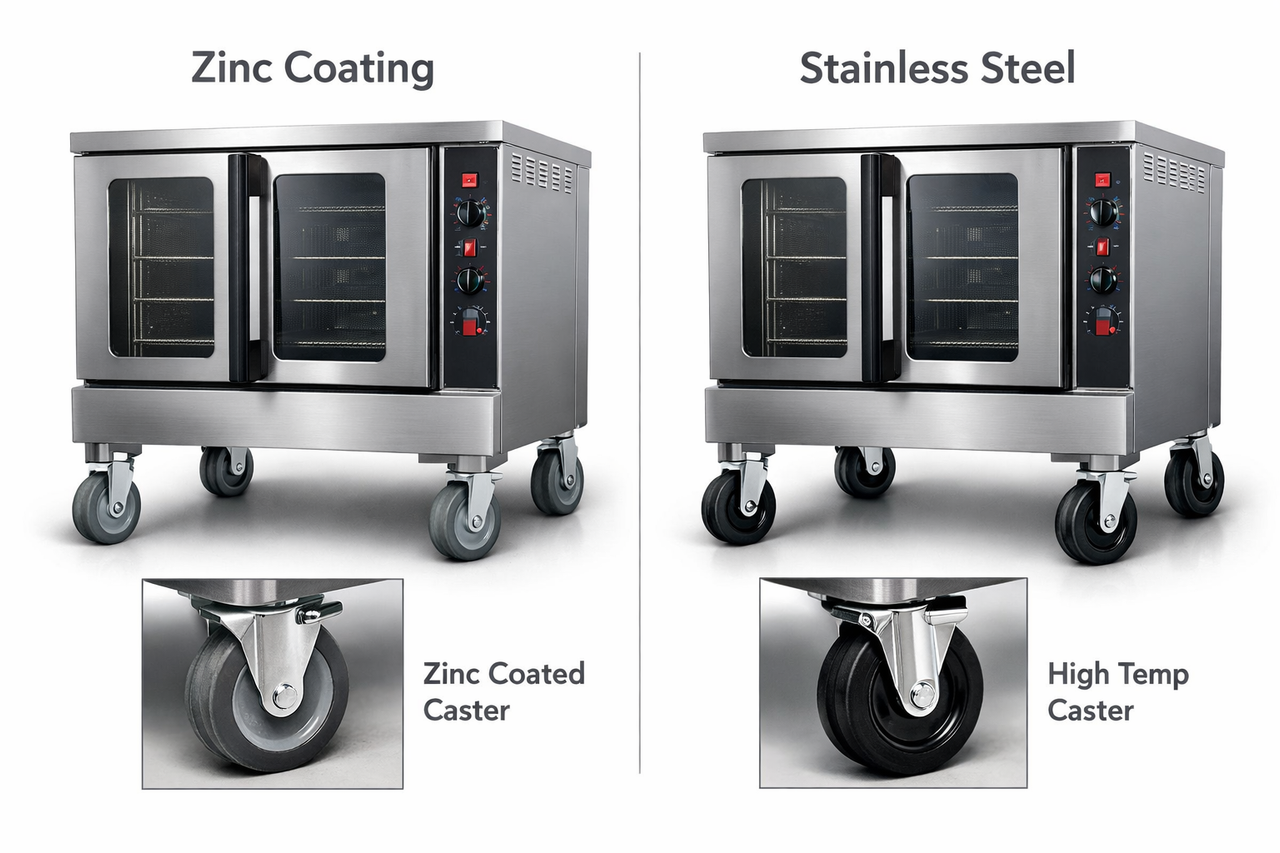
To choose the proper product of oven caster wheels you need a clear strategy. You can use these to replace or modify your bunpan or rack pan trays EDL Hi-temperature Casters. Following these steps will enable you to draw a practical decision. You will not make costly mistakes.
Your 4-Step Selection Checklist
-
Check Your Temperature: What is the maximum heat the caster will see? Is it for a short time (intermittent) or a long time (continuous)? This is the most important question.
-
Calculate Load Capacity: Add the weight of your cart and its heaviest load. Divide that total by three. This gives you a safe load capacity per caster. This accounts for uneven floors.
-
Analyze Your Environment: Is the area clean like a food-grade bakery? Or is it dusty like a workshop for casters for ceramic kilns? Will the casters be washed down?
-
Consider Your Floors: Do you need to protect your floors from marks or damage? Is it important for the cart to be easy to push?
Application-Specific Recommendations
In different situations, different tools are needed. The same goes for high-temperature casters. We provide EDL Hi-Temp 5inch 250kg Plate Swivel Caster H73115-H735-H6.
| Application | Key Challenges | Recommended Wheel | Recommended Bearing/Grease | Key Rig Feature |
|---|---|---|---|---|
| Casters for Bakery Ovens | Food safety, washdowns, oils | Glass-Filled Nylon | Sealed bearing with food-grade high-temp grease | Stainless Steel |
| Casters for Proofing Racks | Moderate heat, high humidity | High-Temp Nylon or Phenolic | Sealed bearing with high-temp grease | Zinc-plated or Stainless |
| Casters for Hot Workshop Carts | General heat, various loads | Phenolic or Glass-Filled Nylon | High-temp grease bearing | Heavy-duty zinc-plated rig |
| Casters for Ceramic Kilns | Extreme heat, heavy loads, dust | Cast Iron or Ductile Steel | Sintered iron bushing (no grease) | Heavy-duty forged steel |
Maintenance for Heat Resistant Casters
After choosing the right heat resistant casters supplier, you need to maintain them well. Just a simple checking routine may increase their lifespan significantly.
-
Regular Cleaning: Remove flour, dust, and other debris. Buildup can trap heat and cause the wheel to fail faster.
-
Inspect for Damage: Before and after use, look for cracks in phenolic wheels. Look for flat spots on nylon wheels.
-
Check Roll and Swivel: Push the cart to make sure it rolls easily. Check that the swivel casters turn freely. If they are stiff, it is a sign of bearing failure.
-
Re-Greasing Schedule: If your casters have grease fittings, create a schedule to add new high-temperature grease. The hotter the use, the more often you should re-grease.
Frequently Asked Questions (FAQ)
What is the high temperature standard for phenolic wheel casters?
Standard phenolic wheel casters are typically rated for continuous use at up to 425°F (218°C). They can tolerate short, intermittent exposure of up to 475°F (245°C). Nevertheless, they may become brittle after several cycles of heating and cooling.
How do I select the best casters for a bun rack?
For casters for baking ovens, you will require a wheel that is non-marking, food-safe, and can manage high heat. The high-temp nylon/PA wheel with a sealed heat-resistant grease bearing is the best option. Also, the use of a stainless steel rig is suggested to deal with washdowns.
The bearing grease in my caster is failing all the time. What is the problem?
You are probably using a standard grease caster. This grease liquefies and evaporates at temperatures above 250°F (121°C). It is a must to use specific casters which are design with the use of high-temperature grease. They are special and have to remain so at 500°F (260°C) or more.
Are all stainless steel casters safe for high temperatures?
No. "Stainless steel" simply means the rig is rust-resistant. The wheel and bearing also need to be rated for high temps. A stainless rig with a standard rubber wheel will still melt in an oven. Always check the temperature rating for all components.
What differ high-temp nylon and regular nylon casters?
The main difference is that a high-temp nylon/PA wheel is made with glass fibers mixed in and some other heat stabilizers. Regular nylon softens around 200°F (93°C). A specially formulated glass-filled nylon wheel can withstand intermittent temperatures of up to 550°F (287°C). This makes it the right choice for use in ovens.
{ "@context": "https://schema.org", "@graph": [ { "@type": "FAQPage", "mainEntity": [ { "@type": "Question", "name": "What is the maximum temperature for standard phenolic wheel casters?", "acceptedAnswer": { "@type": "Answer", "text": "Standard phenolic wheel casters are generally rated for continuous use up to 425°F (218°C). They can handle short, intermittent exposure up to 475°F (245°C). However, they can become brittle with repeated heating and cooling cycles." } }, { "@type": "Question", "name": "How do I choose the right casters for a bakery oven rack?", "acceptedAnswer": { "@type": "Answer", "text": "For casters for bakery ovens, you need a wheel that is non-marking, food-safe, and can handle high heat. A high-temp nylon/PA wheel with a sealed heat-resistant grease bearing is the best choice. Using a stainless steel rig is also recommended to handle washdowns." } }, { "@type": "Question", "name": "My caster's bearing grease keeps failing. What's wrong?", "acceptedAnswer": { "@type": "Answer", "text": "You are likely using a caster with standard grease. This grease liquefies and burns off at temperatures above 250°F (121°C). You must use casters that are specifically built with high-temperature grease, which is designed to stay stable at 500°F (260°C) or higher." } }, { "@type": "Question", "name": "Are all stainless steel casters good for high temperatures?", "acceptedAnswer": { "@type": "Answer", "text": "No. "Stainless steel" only refers to the caster rig, which resists rust. The wheel and bearing must also be rated for high temperatures. A stainless steel rig with a standard rubber wheel will still melt in an oven. Always check the temperature rating for all components." } }, { "@type": "Question", "name": "What's the main difference between high-temp nylon and regular nylon casters?", "acceptedAnswer": { "@type": "Answer", "text": "The key difference is that a high-temp nylon/PA wheel is mixed with glass fibers and other heat stabilizers. Regular nylon softens around 200°F (93°C). A specialized glass-filled nylon wheel can handle intermittent temperatures up to 550°F (287°C), making it the right choice for oven use." } } ] }, { "@type": "Person", "name": "" } ] }