Caster Wheel Obstacle Testing
Caster Testing Guide Can Your Caster Wheels Survive Uneven Floors?A caster that rolls smoothly on a laboratory floor may not perform the same way after repeatedly crossing joints, thresholds, grooves, and raised obstacles. Obstacle testing helps verify that the complete caster can withstand real-world impact and continue operating reliably on uneven surfaces. |
Why Smooth-Floor Testing Is Not Enough
Actual floor conditions vary from one customer to another. Industrial caster wheels may need to cross expansion joints, door thresholds, floor gaps, metal tracks, debris, or other raised sections during daily operation.
Each impact transfers a sudden load through the tread, wheel center, axle, bearing, fork, swivel assembly, and mounting plate. After repeated impacts, a weak caster may develop tread cracks, delamination, abnormal wear, bearing looseness, bracket deformation, or difficult swiveling.
Obstacle testing evaluates the entire caster system under repeated impact—not only whether the wheel can roll on a flat surface.
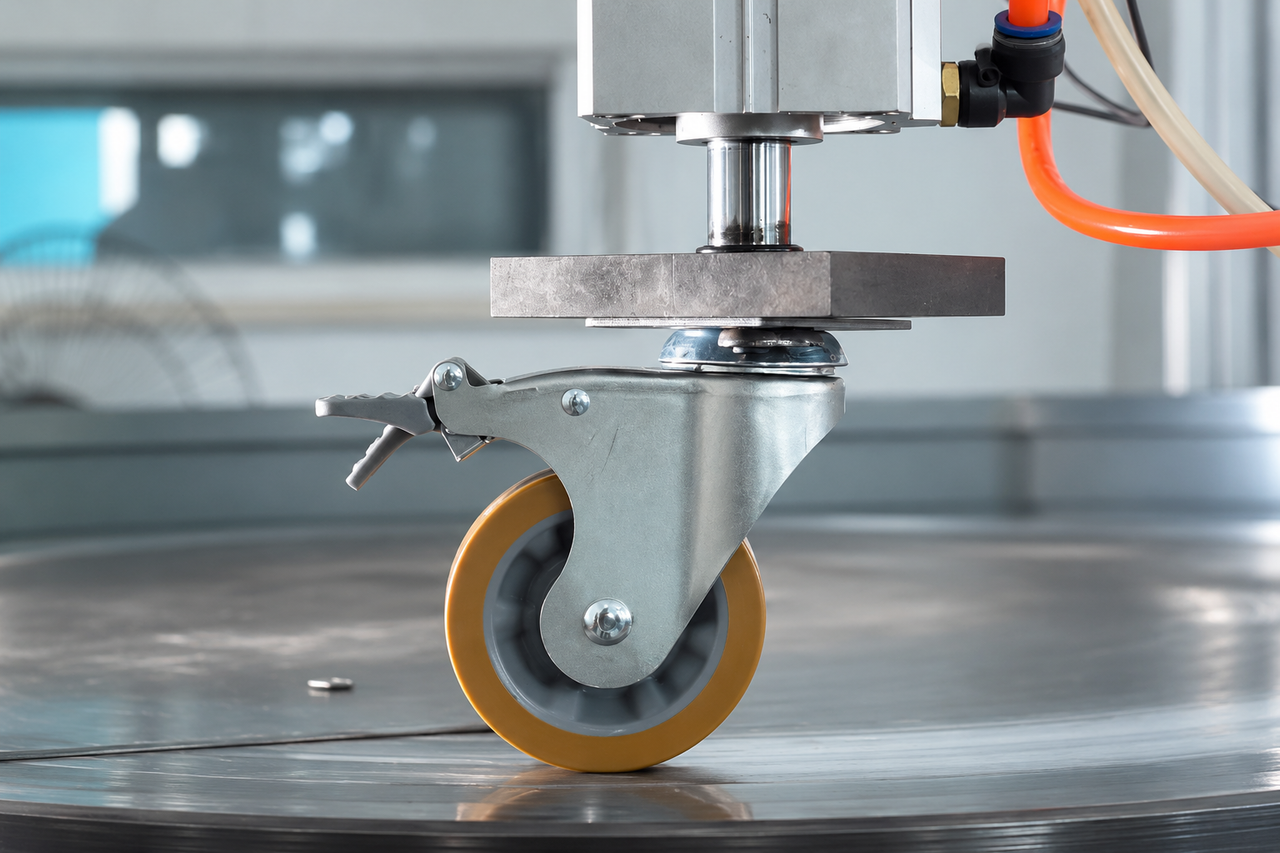
| What Is an Obstacle Test?During an obstacle test, a caster or wheel carries a specified load and travels repeatedly on a test machine while crossing obstacles of defined dimensions. Unlike an ordinary running test on a smooth track, every crossing creates an impact. Repetition accelerates the stresses that a caster may experience over a much longer period in actual service. The test can reveal weaknesses in the tread, wheel center, axle, bearing or bushing, fork, swivel head, and mounting structure before the caster enters regular production use. |
GB/T 14687-2011 Test Conditions
GB/T 14687-2011, Industrial Castors and Wheels, defines test conditions for non-powered industrial castors and wheels used on industrial vehicles and equipment.
20℃ ± 10℃
Ambient TemperatureThe test is conducted within the specified environmental temperature range. | 4 ± 0.4 km/h
Travel SpeedThe wheel crosses the obstacles at a controlled test speed. | Level & Rigid
Test SurfaceThe running surface must be horizontal and hard. |
Obstacle Height Depends on Tread Hardness
The obstacle height h is calculated as a percentage of wheel diameter D. Soft and hard wheels use different percentages because their deformation and shock-absorption behavior are different.
h = 5% of D
Soft Wheel: Hardness < 90 Shore AFor a 100 mm soft wheel, the specified obstacle height is 5 mm. | h = 2.5% of D
Hard Wheel: Hardness ≥ 90 Shore AFor a 100 mm hard wheel, the specified obstacle height is 2.5 mm. |
Soft treads can deform and absorb part of the impact. Hard wheels deform less, so impact is transmitted more directly into the wheel and caster structure.
How the Obstacles Are Arranged
100 mm
WidthThe normal cross-section width b. | r = h
Edge RadiusThe rounded edge radius equals obstacle height. | 1–3 m
SpacingDistance s between adjacent obstacles. | s ≠ kπD
Non-Repeating ContactSpacing avoids repeated impact on one tread position. | 45°
Alternating AngleAdjacent obstacles alternate left and right. |
The alternating 45-degree layout exposes the caster to impacts from both sides, while the spacing rule prevents the same section of tread from hitting every obstacle.
What Must Pass After 500 Crossings?Completing the running cycle is not enough. After crossing 500 obstacles under the specified conditions, the caster or wheel must still meet the standard’s functional and structural requirements. A wheel that still rotates but has a deformed bracket, loose bearing, cracked tread, or abnormal local wear cannot be considered satisfactory. | 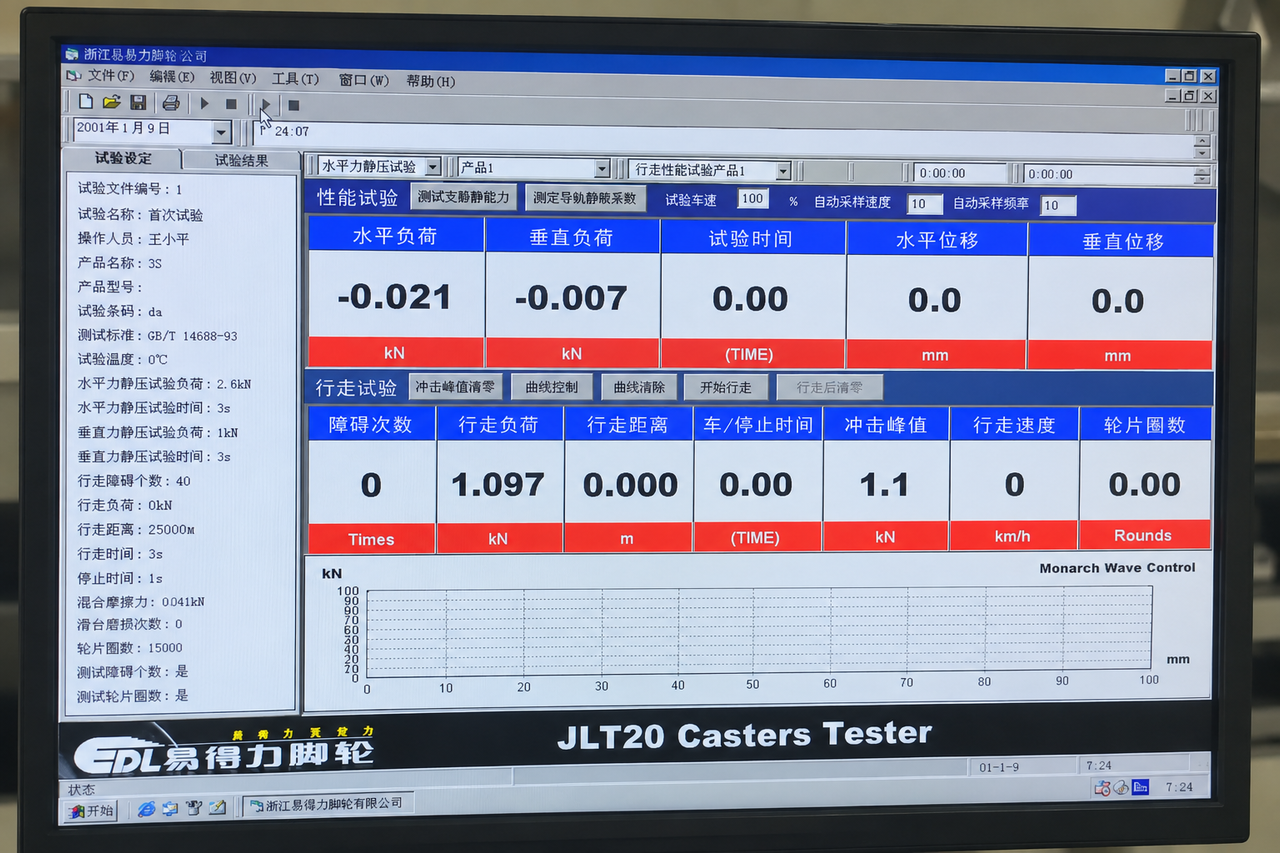
|
✓
Tread ConditionNo cracks, separation, or excessive localized wear. | ✓
Caster StructureNo abnormal damage or permanent deformation that affects use. | ✓
Bearing or BushingNormal rotation without binding, loosening, or detachment. |
What Determines the Test Result?
Obstacle resistance is affected by more than the tread material. Wheel diameter, tread width and resilience, wheel-center structure, axle diameter, bearing type, fork thickness, swivel design, load, speed, and obstacle height all influence the result.
Larger wheels generally cross obstacles more easily. Resilient treads can absorb impact and reduce noise, while harder wheels often provide lower rolling resistance but transmit more shock into the structure.
For this reason, rated load alone cannot show how a caster will perform on an uneven floor. The complete design and the actual test conditions must be considered together.
A Customer Test More Demanding Than Usual
Most EDL industrial casters are tested according to the relevant GB/T 14687-2011 conditions. However, European standards, American standards, industry specifications, and individual manufacturers may use different speeds, loads, obstacle profiles, or crossing counts.
One customer once specified an obstacle considerably higher than the level used in our normal testing. At first, we expected that such a severe impact could cause the sample to fail.
We reviewed the customer’s drawing and test requirements, then confirmed the wheel diameter, tread material, wheel-center structure, bracket strength, and mounting dimensions before producing the sample.
The finished sample successfully passed the customer’s demanding obstacle test. The result showed that caster performance cannot be judged from catalogue load capacity alone—a well-matched wheel and bracket structure can make a decisive difference under repeated impact.
When a customer provides a different test method, EDL can evaluate the requirements, build the sample accordingly, and verify performance under the specified conditions.
Information Needed for Uneven-Floor Applications
Load & QuantityEquipment weight, number of casters, and load distribution. | Obstacle ProfileMaximum height, width, shape, and spacing of obstacles. | MovementTravel speed, daily distance, frequency, and manual or powered operation. | Floor & PrioritiesFloor material plus noise, cushioning, steering, and rolling-resistance needs. |
Test for the Floor the Caster Will Actually Face
Obstacle testing is an important way to evaluate the impact resistance and long-term reliability of industrial caster wheels. It reproduces the joints, raised sections, and uneven surfaces that cannot be represented by a smooth running test alone.
EDL can test according to relevant GB/T 14687-2011 conditions or evaluate other national, industry, and customer-specific methods.
For unusual obstacles or demanding operating conditions, sample testing provides stronger evidence than specifications alone.
Need Casters for Uneven Floors? Tell EDL your equipment load, wheel diameter, speed, obstacle dimensions, floor condition, and required number of crossings. We can recommend a suitable caster and evaluate a custom test plan. | Get A Quote |