Anti Tangle Caster Wheels: Ultimate Guide for Textile Mills
Stop the Snag: The Ultimate Guide to Anti-Thread Casters for Textile Factories
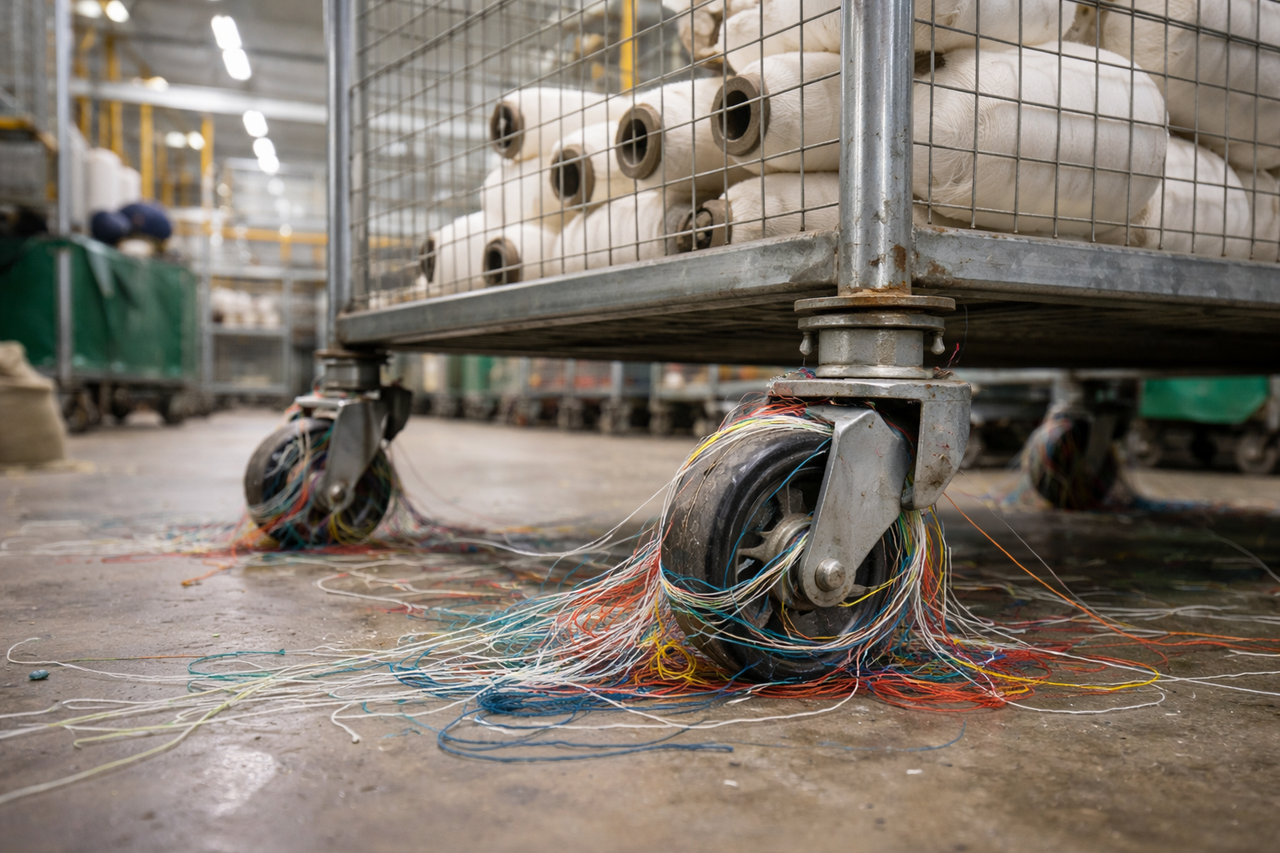
At a recent trade fair, a manager from a large textile factory shared their biggest problem. Production carts kept getting stuck. The reason was always the same. Threads and fibers wrapped around the caster wheels. This seized them up completely. This small problem caused huge delays.
For any spinning mill or weaving plant, picking the right caster matters a lot. It is not a small detail. It is a big decision that affects your whole operation. The right anti-tangle caster wheels keep your production floor moving well.
Key Takeaways
Standard casters fail in textile plants. Threads wrap around the axle. Lint clogs open bearings.
True fiber resistant caster wheels need two key features. They are full metal thread guards and sealed bearings.
Pick wheel materials based on how you use them. Use polyurethane for floor protection. Use phenolic for heavy loads on concrete.
Casters for spinning machines need to handle fine fibers. Casters for weaving equipment must resist stronger, longer threads.
Check and clean even the best anti-tangle casters regularly. This ensures a long service life in a harsh textile environment.
The Hidden Cost of Caster Failure
A seized caster on a roving frame or fabric cart stops everything. What seems like a small hardware issue becomes a major expense. Using the wrong casters in a lint-heavy environment leads to problems you can predict. These problems cost money.
These problems are not just annoyances. They directly hurt your profits. The results include: * Unplanned downtime for machines and transport carts. * Higher labor costs for constant cleaning and maintenance. * Frequent caster replacement and repair expenses. * Damage to expensive factory floors from dragged, seized wheels. * A major drop in overall operational efficiency.
Why Standard Casters Fail with Lint
Generic casters are not built for the challenges of a textile factory. We see them fail for a few common reasons. Understanding why they fail helps you choose the right casters.
The main issue is their open design. Threads and fibers easily get into moving parts.
Problem/Cause* Problem: The wheel cannot spin freely. * Cause: Standard casters are fitted with open bearings. Dust and lint get in. They mix with the grease and form a thick sludge. This prevents the ball bearings from spinning. * Problem: The wheel locks and refuses to swivel or roll. * Cause: There is a small space between the wheel and the metal fork that supports it. Long threads from weaving or spinning tightly wrap the axle in that gap. This causes a complete jam. * Problem: The wheel itself is damaged and leaves marks. * Cause: Soft-wheel materials can adhere to fibers. Debris on the floor can also get trapped in the wheel. This leads to the wheel tearing up the floor.
Anatomy of a Fiber-Resistant Caster
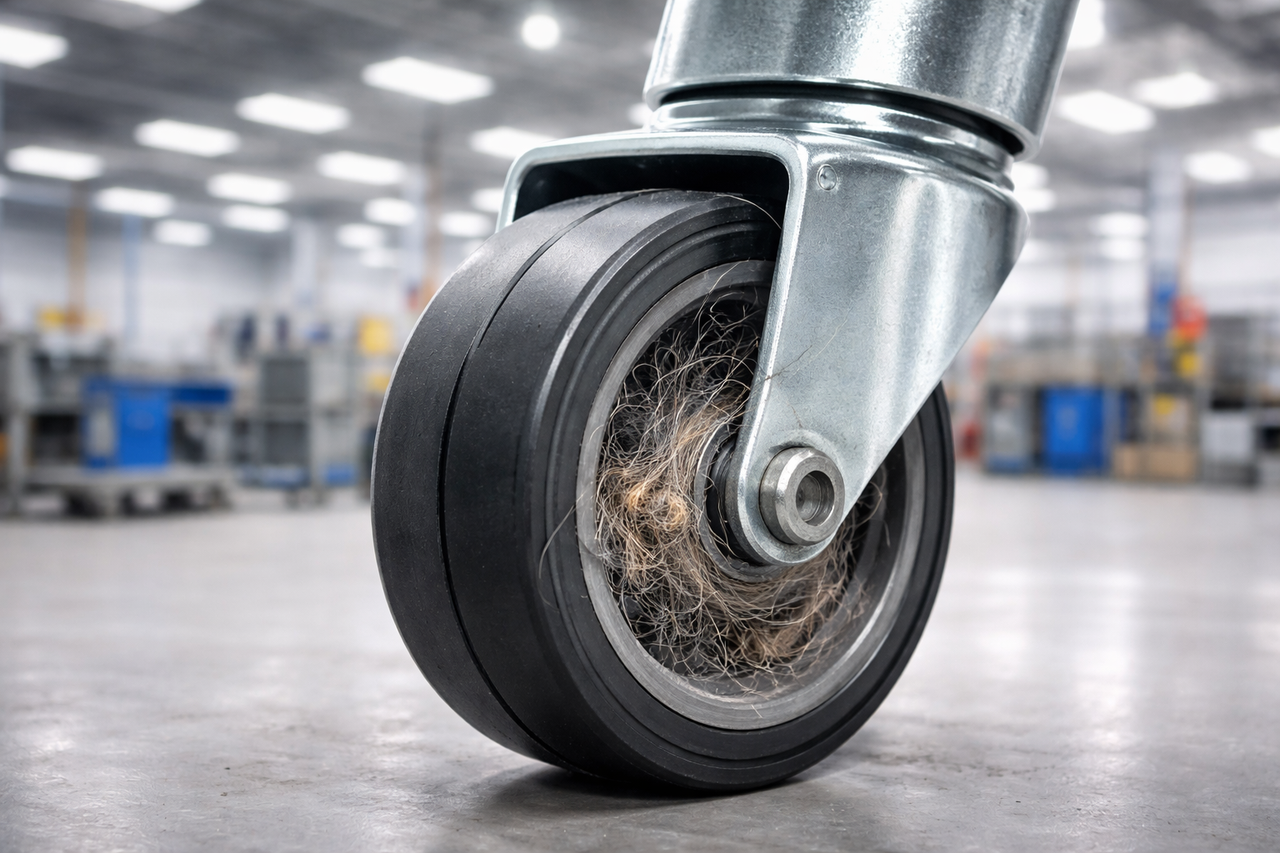
To solve the thread problem, you need casters designed to keep fibers out. These are often called anti tangle caster wheels or casters with thread guards. Let's break down the essential parts you should look for.
The First Line of Defense: Thread Guards
Thread guards are shields that cover the gap between the wheel and the fork. They are the most important feature for any caster used in a textile factory. They physically block threads from reaching the axle.
Full Metal Thread Guards: These are disc-shaped steel plates fixed to both sides of the wheel. They give the best protection against strong threads found in weaving and spinning. They are durable and prevent almost all tangling.
Partial or Plastic Thread Guards: These provide some protection but are less effective. They may not fully cover the axle area. They can break under heavy use. For serious industrial textile uses, we always recommend full metal thread guards.
| Thread Guard Type | Pros | Cons | Best For |
|---|---|---|---|
| Full Metal | Maximum protection, very durable, resists strong threads. | Higher initial cost. | Weaving, spinning, heavy-duty carts. |
| Partial Plastic | Lower cost, provides basic protection. | Can break, may not stop fine lint, less effective. | Light-duty use, less critical areas. |
| Integrated (in wheel) | Sleek design, no extra parts. | Often found on light-duty casters, not robust enough for factories. | Office chairs, not industrial machinery. |
Some designs, like simple Anti-Tangle Swivel 6inch Casters, have the anti-hair design built-in. While great for an office, they lack the robust metal guards and sealed bearings that are needed for heavy factory carts and machinery.
The Core of Smooth Operation: Sealed Bearings
Even with thread guards, tiny lint fibers can still get in. That is why sealed bearings are the second most crucial part. They keep the core of the wheel clean.
Sealed Precision Ball Bearings: This is the best option. The bearings are sealed on both sides. This makes it almost impossible for dust and lint to get in. This ensures a smooth, easy roll for years.
Sealed Roller Bearings: These are a strong choice when you have to deal with very high loads. They also come with seals to protect the internal rollers from debris.
Raceway Seals: Look for casters that have a sealed swivel section as well. This protects the kingpin and bearings that allow the caster to turn. This will ensure smooth steering.
The Right Contact Point: Wheel Materials
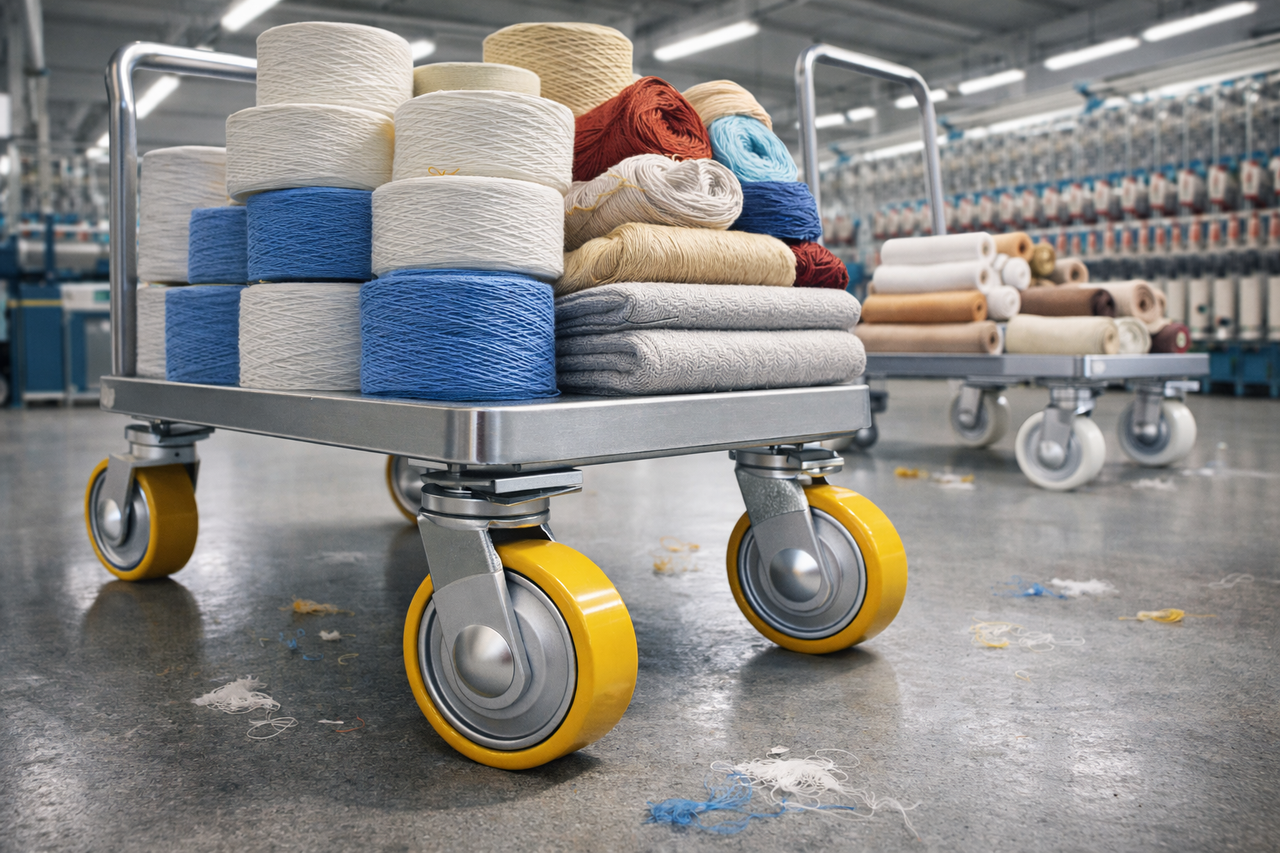
The wheel material itself can help reject fibers and can withstand the factory environment.
Polyurethane: This is an excellent all-around choice that is tough, non-marking, and has a smooth surface that sheds debris.
Thermoplastic Rubber (TPR): This material is softer, provides quiet movement, and good floor protection. It is a good choice for lighter carts.
Phenolic or Nylon: These are very hard materials that are great for high-capacity loads. They are excellent at shedding fibers. However, they can be noisy on certain floors and may damage coated surfaces.
A Practical Selection Guide
Choosing the best anti-thread caster wheel will depend on the particular machine or cart. The following is a guide based on our experience in textile mills.
For Spinning Machines and Roving Frames
Things to Consider: This area has a lot of loose fine fibers. Carts and machines carry moderate loads and are moved frequently over short distances.
What We Recommend: Use swivel casters with full metal thread guards. Sealed precision ball bearings are a must. Polyurethane or TPR wheels will protect the floors and roll easily.
For Weaving Equipment and Loom Carts
Things to Consider: The loads tend to be much heavier when moving warp beams. The threads are longer and stronger. There might be oil or grease on the floor.
What We Recommend: Choose heavy-duty casters with strong, welded metal thread guards. Opt for wheels made of phenolic resin or polyurethane bonded to a cast iron core. A mix of rigid and swivel casters is common.
For General Purpose Carts
Things to Consider: Carts for yarn, fabric rolls, and waste bins are in use all the time. Their varied loads are distributed over large areas and are mixed with a lot of debris.
What We Recommend: A versatile swivel caster with a brake is the best option. Look for full thread guards and sealed bearings. Polyurethane wheels provide a good mix of durability, capacity, and floor protection. A dependable brake is key for safety.
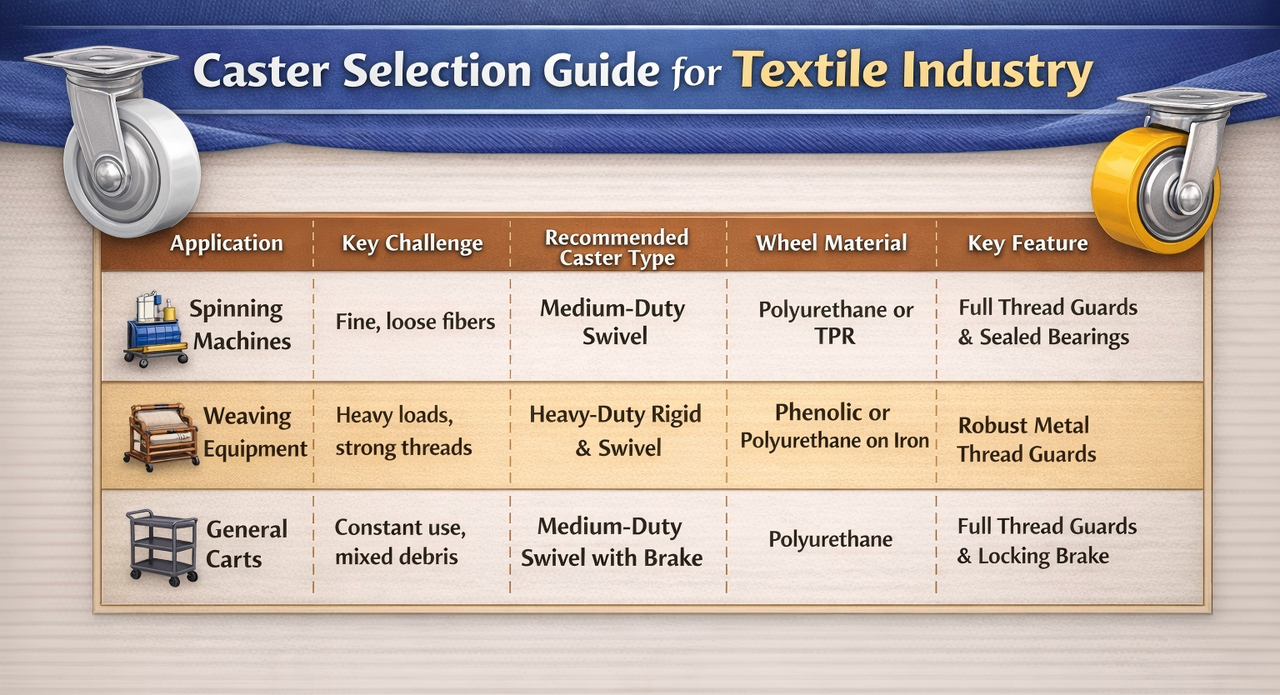
Here is a quick reference table to help you choose:
| Application | Key Challenge | Recommended Caster Type | Wheel Material | Key Feature | | :--- | :--- | :--- | :--- | | Spinning Machines | Fine, loose fibers | Medium-Duty Swivel | Polyurethane or TPR | Full Thread Guards & Sealed Bearings | | Weaving Equipment | Heavy loads, strong threads | Heavy-Duty Rigid & Swivel | Phenolic or Polyurethane on Iron | Robust Metal Thread Guards | | General Carts | Constant use, mixed debris | Medium-Duty Swivel with Brake | Polyurethane | Full Thread Guards & Locking Brake |
Case Study: Weaving Mill Cuts Downtime
We worked with a client whose weaving department was struggling. Their story shows the real-world impact of choosing the right casters.
The Problem: The manager reported that their large fabric transport carts kept getting stuck. Maintenance workers spent 5 to 7 hours every week just cleaning threads out of caster wheels. They also replaced units that had completely seized. This caused major delays in moving finished fabric rolls.
Our Analysis: We visited the site and saw the problem firsthand. The carts used standard, unshielded casters. Tough warp-end threads were wrapped so tightly around the axles that the wheels couldn't move. The open bearings were packed solid with lint and grease.
The Solution: We recommended a complete retrofit. We replaced the old casters with 6-inch heavy-duty swivel casters. Each one had dual-side full metal thread guards. They had sealed precision ball bearings in the wheel. They also had a sealed swivel raceway to protect the steering mechanism.
The Results: The change was immediate and dramatic. Within a month, the number of caster-related maintenance calls dropped by over 80%. Movement of carts became easy and smooth. Not only did this improve production efficiency, but it also made the work a lot safer for the operators.
Installation and Maintenance Tips
Even the best fiber resistant caster wheels need some care to perform well in a tough environment like a textile mill.
Proper Installation: Make sure the caster's top plate or stem is securely fastened to the cart or machine. The caster should be perfectly vertical to prevent uneven wear.
Scheduled Inspections: During routine equipment checks, do a quick visual inspection of the casters. Look for any large pieces of debris that might have gotten past the thread guard.
The "Blow-Out" Technique: Use compressed air to periodically blow out any surface lint from the wheel and guard area. This simple step can prevent buildup over time.
Check for Wear: While many modern casters are very durable, a textile plant is an extreme environment. Inspect the wheel tread for damage and evaluate the swivel action. Even some casters marketed as EDL Anti-winding Casters benefit from a proactive inspection schedule in such demanding conditions.
Investing in the right anti tangle caster wheels is an investment in uptime and efficiency. By choosing casters with full thread guards and sealed bearings, you can stop the snag and keep your operations rolling smoothly.
Frequently Asked Questions (FAQ)
Q1: Are "casters with thread guard" and "anti-tangle casters" the same thing?
A: Mostly, yes. "Thread guard" is the name of the specific part. It is the shield that protects the axle. "Anti-tangle" or "fiber-resistant" is the benefit it provides. When buying for a textile factory, always look for casters specifically advertised with robust, full metal thread guards for the best performance.
Q2: Can we just add thread guards to our existing casters?
A: While you can buy aftermarket thread guards, it is often not a complete fix. If your current casters have unsealed bearings, fine lint and dust will still get inside and cause them to fail. For the best results, we recommend replacing the entire caster with a unit that has both integrated thread guards and sealed bearings.
Q3: What is the best caster for carts that go into dyeing and finishing areas?
A: For wet areas or places with chemicals, you need more than just thread guards. You should look for casters with stainless steel forks, axles, and hardware. It will prevent rust and corrosion. A polyurethane wheel is also a good choice because it resists a lot of chemicals.
Q4: How much load capacity do I need for a caster on a spinning machine?
A: First of all, you need to find out the total weight of the machine with a full load. Divide that weight by the number of casters you are going to use. For instance, a 1,200 kg machine on 4 casters needs each caster to be rated for at least 300 kg. We highly recommend adding a safety factor of 25-30%. So, you should go for a caster rated for 375-400 kg. This is far beyond the capacity of standard EDL Anti-Winding Heavy 6inch Caster, which are not made for industrial loads.
Q5: Do fiber-resistant caster wheels work on all floor types?
A: Yes, but you have to match the wheel material to your floor to avoid damage. Harder wheels, like phenolic or nylon, are good for smooth, durable concrete floors. For painted, coated, or more delicate floors, softer wheels like polyurethane or thermoplastic rubber (TPR) are better. They offer floor protection and quieter operation.
{ "@context": "https://schema.org", "@graph": [ { "@type": "FAQPage", "mainEntity": [ { "@type": "Question", "name": "Are "casters with thread guard" and "anti-tangle casters" the same thing?", "acceptedAnswer": { "@type": "Answer", "text": "Mostly, yes. "Thread guard" is the name of the specific part—the shield that protects the axle. "Anti-tangle" or "fiber-resistant" is the benefit it provides. When buying for a textile factory, always look for casters specifically advertised with robust, full metal thread guards for the best performance." } }, { "@type": "Question", "name": "Can we just add thread guards to our existing casters?", "acceptedAnswer": { "@type": "Answer", "text": "While you can buy aftermarket thread guards, it is often not a complete fix. If your current casters have unsealed bearings, fine lint and dust will still get inside and cause them to fail. For the best results, we recommend replacing the entire caster with a unit that has both integrated thread guards and sealed bearings." } }, { "@type": "Question", "name": "What is the best caster for carts that go into dyeing and finishing areas?", "acceptedAnswer": { "@type": "Answer", "text": "For wet areas or places with chemicals, you need more than just thread guards. Look for casters with stainless steel forks, axles, and hardware. This prevents rust and corrosion. A polyurethane wheel is also a good choice as it resists many chemicals." } }, { "@type": "Question", "name": "How much load capacity do I need for a caster on a spinning machine?", "acceptedAnswer": { "@type": "Answer", "text": "First, find the total weight of the machine with a full load. Divide that weight by the number of casters you will use. For example, a 1,200 kg machine on 4 casters needs each caster to be rated for at least 300 kg. We strongly recommend adding a safety factor of 25-30%, so you should choose a caster rated for 375-400 kg. This is far beyond the capacity of standard Caster Wheels For Furniture Casters For Appliances, which are not built for industrial loads." } }, { "@type": "Question", "name": "Do fiber-resistant caster wheels work on all floor types?", "acceptedAnswer": { "@type": "Answer", "text": "Yes, but you must match the wheel material to your floor to prevent damage. Harder wheels like phenolic or nylon are great for smooth, durable concrete floors. For painted, coated, or more delicate floors, softer wheels like polyurethane or thermoplastic rubber (TPR) are better because they offer floor protection and quieter operation." } } ] }, { "@type": "Person", "name": "" } ] }